


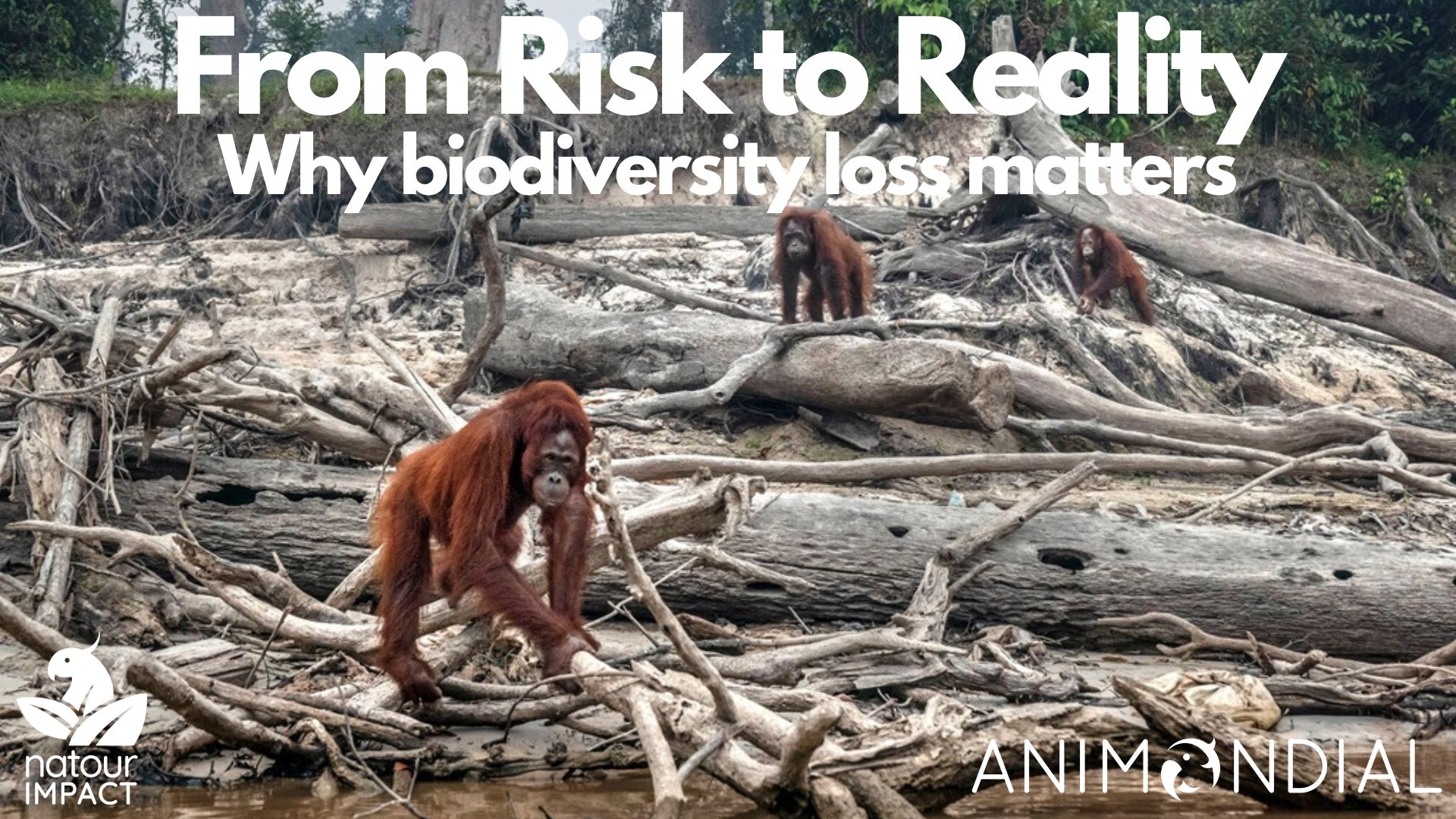
28 Jan From Risk to Reality: Why Biodiversity Loss Matters
Over the past five years, the business risk from biodiversity loss and ecosystem collapse has increased in the World Economic Forum (WEF) Global Risks Report, reaching #2 in the long-term (10-year) rankings. This signals growing consensus that nature loss is one of the most severe threats to society and the global economy over the coming decade.
This trend is not abstract. It mirrors mounting scientific evidence from the Intergovernmental Science-Policy Platform on Biodiversity and Ecosystem Services (IPBES) that ecosystems are degrading at unprecedented rates, with profound implications for worldwide economic stability – particularly for sectors highly dependent on nature, such as tourism.
“We can no longer continue to destroy the diversity of life. This is our responsibility towards future generations … we can and must all mobilize, urgently and together, to save our planet and thus humanity.”
Audrey Azoulay, Director-General of UNESCO
What the Data Says: A Rising Risk Profile
The WEF Global Risks Report, informed by thousands of experts across business, government, and civil society, ranks risks by both impact and likelihood over different time horizons. While biodiversity loss is outweighed by geopolitical risk in the short-term (two-year), its consistent presence in the long-term rankings reflects deep concern about irreversible ecological change and systemic socioeconomic impacts over the next decade.
IPBES reinforces this assessment, warning that biodiversity loss is already undermining the systems that support economies and societies:
“Biodiversity is essential to our very existence, supporting our water and food supplies, our health and the stability of the climate. … These environmental crises are causing substantial economic and social damage”.
IPBES Thematic Assessment on Biodiversity, Water, Food and Health (2025)
Similarly, a recent UK Government national security assessment concludes that “global ecosystem degradation and collapse threaten UK national security and prosperity” as they are already causing crop failures, intensified natural disasters and infectious disease outbreaks and are likely to lead to increasing geopolitical instability, economic insecurity and conflict. This reinforces that biodiversity loss is no longer a distant environmental concern, but a present and escalating risk that requires immediate, proactive action from governments and businesses alike.
Why Biodiversity Loss is a Business Risk
IPBES highlights that businesses both depend on and impact biodiversity, making ecosystem decline a material risk to operations, supply chains, and long-term planning. Nowhere is this more evident than in tourism. Tourism is inherently tied to healthy ecosystems. Biodiversity underpins the landscapes, wildlife, clean water and nature-based experiences that attract millions of visitors annually. When ecosystems degrade, destinations lose their appeal, operational costs rise, and supply chains – from food and materials to water and energy – become more fragile. Over time, this erodes the economic base on which destinations and their communities depend.
From Awareness to Action: Implications for Business Strategy
The rising prominence of biodiversity loss in the WEF risk rankings, combined with IPBES’s scientific findings, is a clear call to action for business leaders.
“Biodiversity is the bedrock of life and a cornerstone of sustainable development… humanity is destroying biodiversity at lightning pace… we must act urgently to put biodiversity on a path to recovery.”
UN Secretary-General António Guterres on International Day for Biological Diversity (2025).
Practical steps for businesses include:
- Assess and monitor operational dependencies & impacts on nature to identify material risks & opportunities.
- Integrate biodiversity into risk registers and strategic planning to identify vulnerable assets and supply chains.
- Invest in nature-positive practices that support conservation priorities and community-led stewardship.
- Advocate for ecosystem protection policies at local, national and industry levels.
- Collaborate on monitoring and data gathering, using robust biodiversity indicators to inform decisions and communicate performance.
A Strategic Imperative
The rising position of biodiversity loss on the global risk agenda reflects a simple truth: ecosystems are foundational to economic health. For tourism, where nature itself is a core asset, the stakes are especially high. Business leaders who act now to integrate biodiversity into strategy and risk management will be better positioned to thrive in a world where ecological realities increasingly shape economic outcomes.
Daniel Turner, ANIMONDIAL